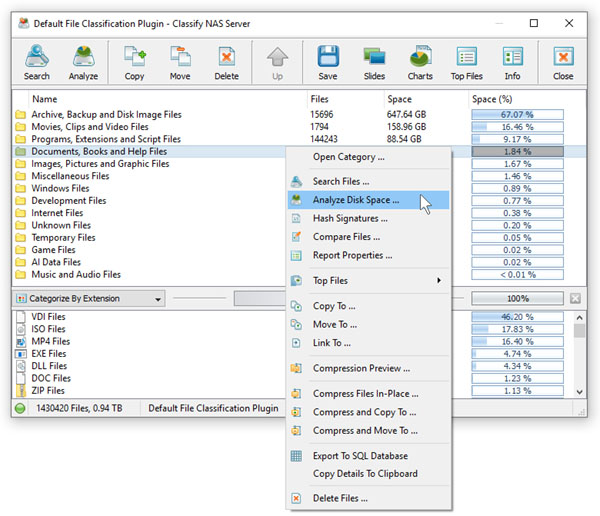
DiskSorter Server and DiskSorter Enterprise provide the ability to automatically detect all servers and NAS storage devices on the network,
classify files in hundreds of servers and/or NAS storage devices via the network, submit reports to the reports database and display charts
showing the disk space usage per server or NAS storage device across the entire enterprise.

In order to analyze disk space usage per server, perform one or more file classification operations on multiple servers and/or NAS storage
devices, open the 'Reports' dialog, press the 'Analyze' button and select the 'Analyze Disk Space Usage Per Host' menu item. DiskSorter will
analyze all reports saved in the reports database and display the hosts analysis dialog showing the disk space usage per host.

The hosts analysis dialog provides the ability to display pie charts and bars charts showing the disk space usage per server or NAS storage
device according to file classification reports saved in the reports database. The user is provided with the ability to select the types
of file classification operations and file system locations to analyze, edit the chart header and footer, copy the chart image to the
clipboard and export graphical PDF reports including pie charts.